
Get humbled more.
Stop getting in the way of your own potential

This post was inspired by this video
Introduction
Some of you aren’t willing to be humbled, and you’ll be in this perennial loop of unfulfillment because you aren’t willing to be challenged on what you believe about yourself.
But first, when you think of being humbled, what comes to mind?
Is it being put on blast for being loud and proud, is it someone being too confident for their own good?
These are situations we would typically associate with being humbled, but what about when you need to humble yourself?
It sounds scary if you have been avoiding a challenge.
On the other hand, it can be empowering to realise you know so little; it takes away the pressure of having to be perfect.
Becoming comfortable with being uncomfortable is a recurring process.
Once we achieve our short-term goals, we can feel deserving of respite from discomfort, all while having the deep desire to grow - but within this is a dissonance.
The fear of disproving a persona you’ve cultivated and built your whole life is holding you back.
When it comes at the cost of becoming the person you wish to be, you have no choice but to confront this incompatibility.
So what does it look like to ‘humble yourself’?
The Identity Trap
In 2024, I wrote a series called Laziness v Complacency (LvC), which explored how complacency played a part in my school life.
I deduced that I had a quiet complacency; one that didn’t manifest itself as being boisterous or condescending, instead it came across in how I pushed myself.
I allowed my identity to be shaped by the outcomes of my actions.
The outcomes are the way people perceive me, react to what I say and do, and the objective outcome of the grades I obtained.
As a result, I created a trap for myself which would lead me to a path of never fulfilling the potential I was meant to achieve.
In an environment where you’re not challenged, this fear is exacerbated, but you’re only as good as the next person.
This idea wasn’t front and centre of my daily life, it functioned like tinnitus that would come to visit every now and then.
Alongside that, I was reminded by my mum of the wider competition beyond school.
Therefore, as I got older I reframed the word “smart” to mean academically able in the case of education.
Outside of education, a smart person is someone that knows how to get what they want – the best definition I’ve heard to date.
But let’s pause.
Why did I reframe the meaning of ‘smart’ specifically?
At the time, ‘smart’ was a word that was loosely thrown around.
In a way, it can be a form of humbling yourself by showing appreciation for something you don’t yet have.
But in my case, the label ‘smart’ was a projection a fixed mindset that was used against me.
That label alone meant trying new things felt like jumping off a cliff because I felt obliged to uphold this belief.
There was an undertone of envy which anchored the way I perceived myself, which would only box me into the persona of being a smarty-pants.
Although I started trying new things relatively early, I could’ve definitely started earlier and with that comes the humility of becoming a beginner again.
To this, I thought to myself:
“If you’re proving someone wrong, you’re probably doing something right. If you’re proving everyone right, you’re probably doing something wrong. You’re playing it too safe from an innocent point of view, but deeper than that, you’re probably contending with the expectation of you as opposed to going for what you want.”
I only started to grow as a person when I struggled under my own accord; whether that’s in the gym, going to an event, or studying alone.
When you’re pushing your hardest for something you really want, you learn about yourself in the process.
Conversely, by hearing the same words, seeing the same demographics, and being in the same bubble – sure if you work hard, you will thrive relative to that environment, but by becoming the smartest in the room, you no longer tend towards fulfilling your potential.
Your challenges grow alongside your ambitions, and you can only aspire to become the things you’ve seen.
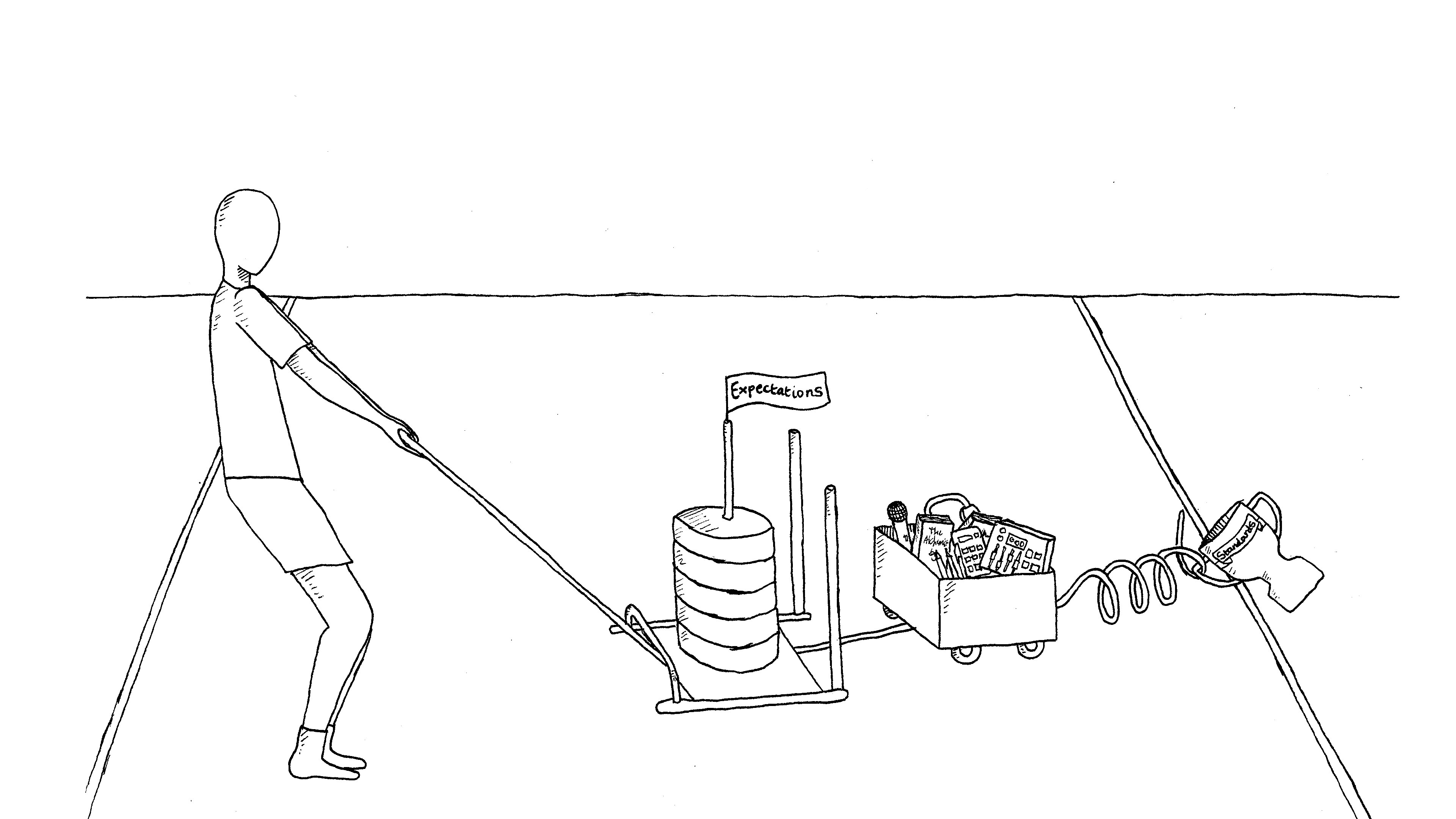
To be, or not to be
With the desire to break from the mould is the need to experiment and explore new territory.
There has to be some leverage, some incentive, or some inclination that makes you want to try something different – you just have to connect with it.
An interesting paradox for ourselves is that we find it much easier to disengage with a reality that is yet to be actualised.
One day, I want to….
you fill in the blank with what sounds nice - not with what you need, and so working towards it is an afterthought.
It’s only later that regret kicks in because you didn’t work towards the aspiration.
The section heading ‘To be, or not to be’ comes from Hamlet’s famous soliloquy where he contemplates whether it’s nobler to endure life’s hardships or to end one’s suffering.
He contends with the pain of life and the fear of death after the murdering of his father, remarriage of his mother, and the thought of avenging his father.
Why I use this heading is two-fold.
Holistically, this links to the metaphor of a ‘living death’ which means being stuck in an unfulfilled life irrespective of the age.
It’s about always feeling stuck in the middle of where you are and where you want to be.
Beyond this, the soliloquy can be an analogy for being between a rock and a hard place.
The pain of life and the fear of what is to come on the other side of death can be interpreted as an amplification of what it feels like to reinvent your identity.
Even with colossal pain, the inclination to change doesn’t oust the fear that brought you to that position in the first place.
In other words, after the triumphs you are still bound to the past fears that shape your risk-taking ability and to overcome that takes great effort.
So how do you experiment then?
It’s all well and good seeing somebody else do it, ‘but my life is too rigid to try something that might amount to nothing, especially when I’ve got something to lose.’
The easy answer is to integrate the new practice over time, like reading 10 pages a day and build that habit.
Let’s be real though.
How many of you are taking the smallest action to the point it seems silly, in order to work towards a default behaviour?
It’s like travelling 10 minutes to the gym, doing 5 minutes of walking, and going back home.
To embed a behaviour in such a way comes with the privilege of having the time and patience to gradually work your way up.
For a lot of us though, the opportunity cost of doing such a thing can seem too great, and so you don’t do anything.
You think, ‘If I’m going to do something, I might as well do it properly’.
So the answer you need is the tough one, which is to get over yourself.
I have framed many situations as now or never, and that alone has been enough activation energy to go for the thing.
For example, there hasn’t been a summer holiday since I finished my GCSEs where I can’t tell you what I did with my time.
There has always been something front of mind in those periods, and the friction between thought and action has been very little due to my persistence to not have regrets.
It comes down to these questions:
If you know that it requires work to become the person you want to be, why haven’t you done the work yet?
Does it matter enough to you?
Do you have a reference point to show that trying something new isn’t as scary or as steep as you make it seem?
The person between you and your potential is yourself.
Follow your intuition
We like to build straightforward personas, concepts, and avatars to the point we forget that we are multifaceted, and it’s the cross pollination between those parts that makes us who we are.
Our tendency to do this grows as we get older.
We want things to be simpler than they are, and that’s fair.
But when it comes to ourselves, being humbled starts by looking within.
A lot of the time, you keep trying to cover your back.
Instead of trusting your intuition, you do the intuitive thing of doing what everyone else would do in that situation.
Little do you know that all you’re doing is blending into the median, and so you’ll get the same results as everyone else.
As a student, what this looks like is cramming study material on one day and decimating your ability to study in the next.
Why do you do this?
Because it’s honourable.
You tell yourself you’re doing the right thing, because objectively the person who works the longest must be the person who wants it most.
That can be true, but more often than not, the person who gets the best results is the one who invests time into their underlying routines, and then the tip of the iceberg is your study technique.
Of course there will be times where the levels have to be cranked up, but phased momentum is something that we looked at in the previous post.
That method of preparing for an interview, exam, or any big event that is entirely on our shoulders, separates logic and ego.
The person who crams because they didn’t study meets a situation that has culminated from ego and/or overconfidence.
Humbling ourself is acknowledging the inherent flaws that every human has, and in this case it is our ability to estimate time.
But before this situation occurs, you aren’t doing enough to be at the standard you set for yourself.
You still don’t invest in yourself because you’re scared of looking foolish if it doesn’t work out.
It’s fear that manifests itself as hustle, so that time you should invest, you see as a trade-off instead of it being part of the process.
You can see this when it comes to working smarter as well as harder.
Ultimately, you’ll pride yourself on a system you’ve convinced yourself is the way you work, even if it is suboptimal.
That is you becoming comfortable with something that used to be uncomfortable, and your intuition will leave you wondering as to why you feel misaligned.
Once you’re comfortable with the uncomfortable, it’s time to go again.
Conclusion
Action breeds confidence.
It comes back to the root of my bias to action.
You won’t be any more likely to step out of what you know if you don’t do it today.
Humbling yourself doesn’t have to be dramatic or embarrassing – it’s a mental shift where you take agency of your own potential instead of letting history write it for you.
There have been so many stories and insights into the silent suffering of those that didn’t take the uncomfortable step when it was called upon them.
At the same time, the courage to do this cannot be feigned.
There has to be a true willingness to see the person on the other side of the fears that keep you from taking that action.
Within that, failure is a part of the process - it’s how you react that dictates your success.
Things will never be perfect, so why don’t you start today?