
Confidence is found in courage.
The longer the wait, the further the jump.

This post was inspired by this video
Introduction
I was flattered.
“You appear so confident.”
I paused.
I’ve never been praised for my confidence before.
There was a humbleness mixed with a sense of shock, maybe because it’s so rare to be complemented on your character, and I had an awareness of this just being the start.
If that perception could be developed from my first podcast clip, do those first few seconds become the standard already?
Confidence is one of those things that you think is innate in a person when you’re growing up - it’s either you have it or don’t.
The truth is I wasn’t always a confident person, and it took years of understanding myself in uncomfortable situations to gain assurance over myself.
It’s simply the trust in oneself.
In this post, we’ll explore how you can develop confidence and what my journey has shown me so far.
Confidence starts with alignment
From my experience, building unshakeable confidence starts with alignment.
If you know yourself, you will serve yourself.
It’s the reason why I can’t definitively say how writing has helped me in my personal life, career, and relationships - it has embedded itself in so many ways.
The frequent self-reflection and outlet for ideas presents itself as posts such as these, but there is also great value in the process.
Coming face-to-face with the ideas that have shaped your outlook for so long is tough.
Can you even articulate it to yourself?
But as you try to represent your ideas in the best way possible, you’re doing the mental gymnastics which is the inner work.
Generally, the practice of forging confidence starts small.
Are you doing the things you said you would do?
Are you doing what you know you should do?
If there is an internal conflict, it will show in your self-esteem.
I think we can underestimate the severity of not keeping promises to yourself.
It’s not just the moral question of ‘if you can’t trust yourself, then who will?’, it’s a concern around the identity you are building for yourself.
Not having personal integrity is like flipping a coin to decide how you are going to show up today.
There’s no intention, no drive, no consistency.
Despite this, we’re obviously not perfect and there will be facets of our lives that are neglected in such a way.
Eventually this positions itself as a high maintenance coping mechanism in our otherwise successful lives.
But this is where courage comes in.
Even when you’re not sure, do it anyways.
I’ll use the example of being nervous.
In the past I’ve had exposure to speaking on camera, but I wasn’t consciously building the skill and therefore didn’t have confidence in my ability to speak on camera.
You have heard of the advice of feel nervous and do it anyway.
It’s a good rule of thumb, but entirely dependent on whether you deem something as being worth the struggle.
My personal motivation is that I like to lean into things that bring fear because I know I’ll be better because of it.
It’s what has led me to public speaking and starting a podcast.
It’s what has led me to sharing my experiences and research to hundreds of people every fortnight.
It’s what has led to me being in a better place mentally and physically.
My journey for years has been me finding ways to branch out of the everyday student life, so my development has been a slow burner in that respect.
On the other hand, if you focused on achieving just one thing, there’s no reason a year from now you could become a completely different person.
The baseline is experimentation
After finishing my GCSEs, my teachers said take a break.
You got the highest grades in the year, take a break.
Guess what...
I was conscious of the fact that I was reasonably competent when it came to my school life, but at this point all I knew was South East London and getting grades.
It’s where the idea of invisible competition was birthed.
How could I become a better version of myself?
So, I felt an urge to experiment – try new things that I wouldn’t usually do.
My hypothesis was that if I didn’t do then I will regret it and fast forward 5 years later, I still hold that belief.
Experimentation looks like breaking the patterns and structures that got you to where you are, and reformulating them to cater towards the person you wish to be.
A perfect example of this was in how I viewed video games.
As I was growing up, they were very much a part of my routine and my way of having time to myself.
I then started to question everything as I got closer to university:
What trade-off am I making when I dedicate time to playing these games?
The time I had to play them was a byproduct of the consistent structure I had when it came to studying and playing football, but as time went on, the studying became more intense as well as my tendency to experiment.
Therefore it was no surprise that when I moved up to university, I didn’t feel any loss or grief as a result of not taking my console with me.
Instead I saw it was an opportunity to expand my interest beyond what I knew at the time, and this is something I wish I did earlier - even before my GCSEs.
Learning about the confidence-competence loop explained why it’s so easy to stick to the things you know, especially when the new things are subject to judgement and scrutiny.
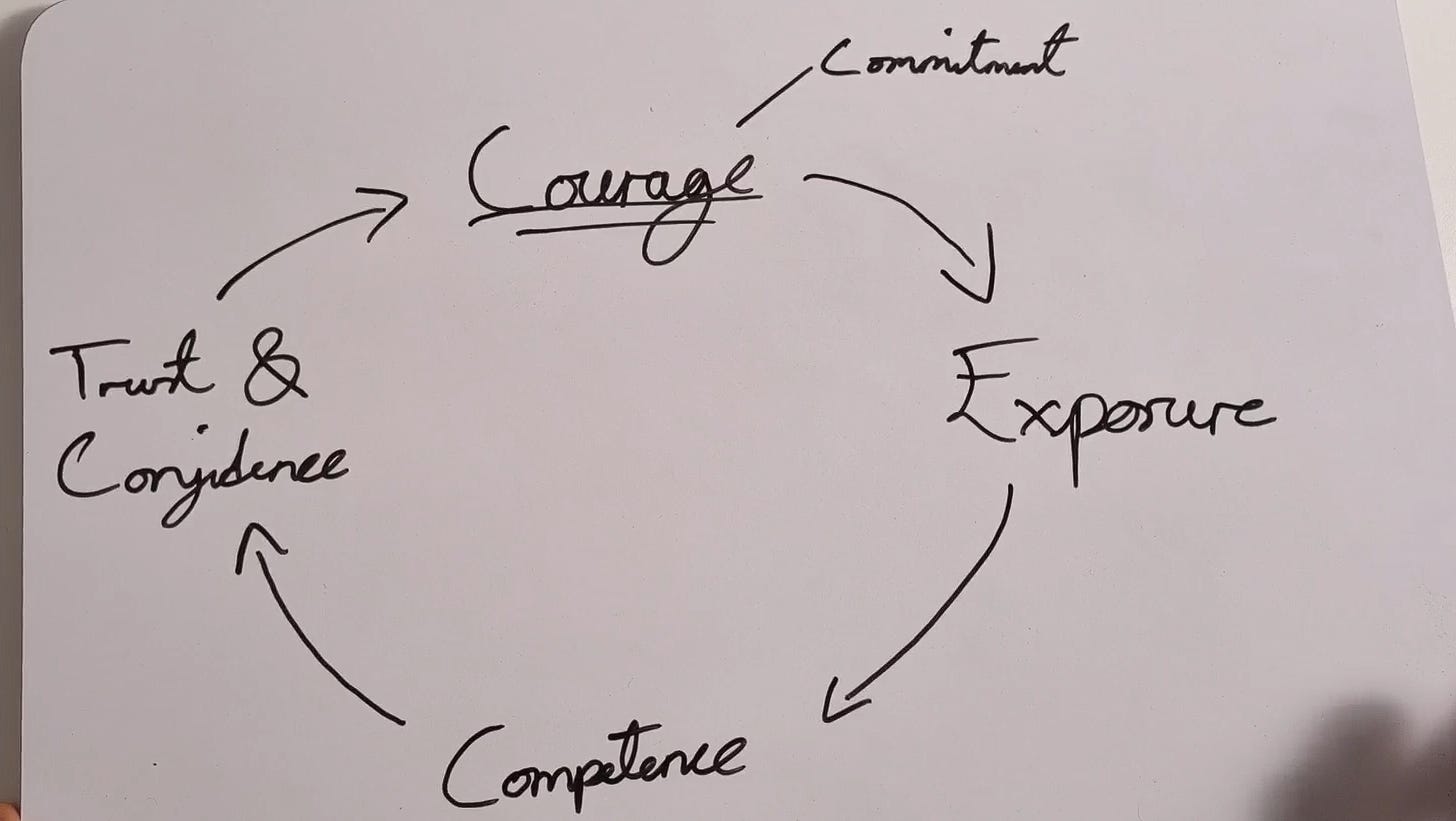
For me, a perfect example is networking and how I became comfortable in that space.
Once I came to terms with not wanting to feel regret because I talked myself out of something, the courage to try new things was always there.
The challenge now is in committing to going to those events and immersing yourself within them; coming out your shell and making the other person feel seen and heard.
I quickly became comfortable with holding space for people because I expressed genuine curiosity when speaking to them.
Exposure doesn’t translate into standing in the corner of the room and expecting confidence to shower over you.
So after putting in the reps with different types of networking events, having different approaches, and learning theoretically how to improve, I developed competence after years of building the skill.
With that comes the trust in oneself to be present in uncertainty.
Can you handle uncertainty?
There’s no classified documents that have secrets on how to be more confident…
As demonstrated above, it’s a whole process that requires real effort.
That in itself is a disincentive, especially if you’re not curious about the activity that’s giving you grief.
Underlying this is our relationship with uncertainty.
This is a staple of many behaviours we naturally gravitate towards.
We want to close that feedback loop to have closure, even if it is premature.
Sometimes this comes at the cost of a better outcome, but the relief of knowing what’s to occur supersedes that in the immediate moment.
The potency of this habit relates to our fear and the question of ‘What if?’
In this case, we want to cover our backs as we rationalise whether or not we would have regrets given we had the opportunity to take a merely acceptable outcome.
But those who are patient and make decisions on their own accord will be the ones that are truly satisfied.
To get better at handling uncertainty, we must have repeated exposure to such circumstances to become more confident in those situations.
This is because preparation becomes less about planning regimented moves to not make a mistake and more about facilitating a competency that can adapt to numerous situations.
This way you can better trust your predictions on the future, and this enables you to be more confident.
However, it must be noted that confidence is not universal once you gain it in a specific capacity.
I think that’s a misconception that many of us have.
We say a person is confident because they are in an area that we value.
It can very much be the case that everyone is confident in some respect, but it’s whether objectively it is allocated within a scope that we personally value.
Reflection
The funniest part about confidence is that if you want to build it, you need to get out of your own way.
Stop using ego and perfectionism as excuses.
Not only this, but confidence isn’t a stack of historical evidence; it is a type of momentum that one has in a particular moment.
After a couple of wins, you garner confidence because you trust in your predictions of future outcomes.
Other times your confidence is rocked or destabilised when something disproves and invalidates the belief your confidence resided on.
But between these two events is a meandering of confidence.
I have found that when being intentional and structured in approaching a specific goal, the confidence from meeting the targets I set for myself emanates in other areas of my life.
On the other hand, if I don’t have a specific structure, not out of choice but as a result of circumstance, the tension between myself and my environment can erode at the confidence I built within the pre-existing structure.
Beliefs about myself are challenged, and I’m forced to come to terms with what habits have stuck and whether I’m the person I say I am.
The longer this goes on, the more you drift towards losing your confidence as you long for a version of yourself that has already passed.
Although we can’t control every environment, event, or situation, our response can dictate whether we continue to fuel our confidence or drain it.
To compound it, we must have a bias to action that serves us in the goals we wish to achieve.
Even if we don’t know the answers, we can still be confident that we are doing the right thing and that mindset has completely changed the way I have seen myself in last 2 years.
The things I fear are also opportunities to grow.